
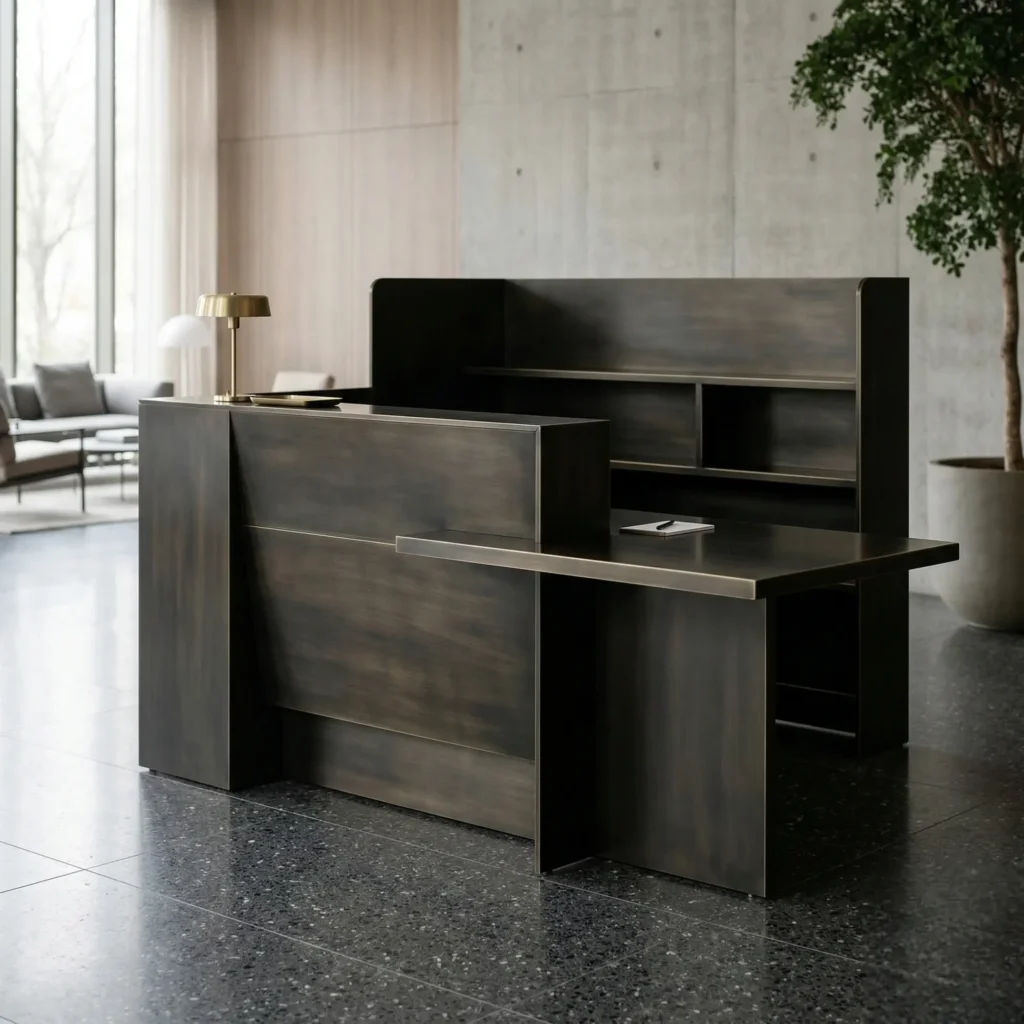
Architectural Metal Finishes and How to Specify Them Correctly

Download Modulux Catalog

There’s a moment in every project when the metal has already been chosen, but the real question is still open. Not whether it’s brass, copper, bronze, aluminum, corten, or stainless steel. The question is how it will show up in the space.

Will it feel quiet and restrained, or dramatic and deep. Will it behave like a clean mirror, or like a material with time layered into it. Most of the time, the answer isn’t in the base metal. It’s in the metal finish.

A metal finish is the language metal uses to speak with light and touch. It sets the direction of reflection, the depth of tone, the consistency between parts, and the way a surface changes after months and years of real use. That’s why architectural metal finishes are never “just aesthetic.” They’re a design decision, a fabrication decision, and a long-term performance decision at the same time.

Architectural metal finishes, in plain terms

An architectural metal finish is a controlled change to the metal’s surface. Sometimes it’s mechanical: brushing, satin work, soft clouding, sanding, polishing. Sometimes it’s chemical: blackening, patina, oxidation, controlled corrosion. In most real projects, it’s a disciplined combination of both.

The goal is to get a look that feels honest to the metal, but stays consistent. Something you can reproduce across parts, maintain without drama, and understand upfront: how it behaves in the exact conditions of your project.

Two principles tend to shape everything.

First, how it reads in light. A finish is an optical decision. The same brass can feel warm and diffuse or sharp and reflective, just from a shift in surface texture.

Second, chemical stability. Every patina and every blackened finish is a reaction. If you want an architectural result, you need to know how to start the reaction, and how to stop it. How to rinse, neutralize, stabilize, and lock the surface so it doesn’t keep drifting unpredictably.

Why metal finishes for architectural design matter

Solid metal has a presence you can’t fake, but it also exposes everything. Every joint. Every change of direction. Every lighting shift. Every fingerprint.

A finish is the tool that gives you control over that reality. It can unify multiple elements into one material language, or separate them quietly. It can calm a large surface, or deliberately sharpen geometry. And it can help a high-touch element hold up to daily use without letting the space “learn” time too quickly.

From a fabrication standpoint, a well-defined finish also reduces risk. When the finish is specified clearly, surface prep, sequence, and the moment you stop, the outcome becomes far more repeatable. Less tone drift between batches. Fewer surprises between parts made on different days. And far fewer cases where the sample looked right, but the site result doesn’t.

A simple finish map: mechanical work and chemical work

Mechanical finishes work through texture and direction. They create rhythm and controlled reflection.

Chemical finishes work through color and depth. They build a layer that shifts the tone of the metal itself, sometimes subtly, sometimes dramatically.

There’s no “better” category here. There’s only fit. Brass and copper respond to patina very differently than stainless steel. Aluminum demands its own process. And corten is its own world, where the finish is essentially a designed aging cycle.

Surface preparation is where the finish begins

Most of the difference between a professional architectural finish and a random outcome starts before the finish even begins.

Degreasing isn’t a technical checkbox. It’s the baseline condition. Residual polishing compounds, oils, silicone contamination, and fine dust can change chemical reactions and create unwanted layers on the surface.

Consistency matters just as much. If sanding or brushing isn’t consistent, the patina won’t be consistent. If the prep is uneven, the light will reveal it.

Good work begins with a clear definition of surface prep level, abrasion method, and a disciplined cleaning routine before you ever touch chemistry.

Mechanical finishes: brushed, satin, clouded, polished

A brushed finish is one of the most architectural tools you can choose. It introduces direction. On brass and bronze, brushing can read warm and tactile, or crisp and linear, depending on grain, pressure, and post-refinement. On stainless steel, brushing can feel precise and calm. On aluminum, it often reads clean and minimal, especially when you’re building a very controlled material palette.

A satin finish sits in the balance point. It keeps the material presence, but lowers glare. It’s a strong choice for larger surfaces, as doors, wall cladding, panels, especially where light changes throughout the day.

Clouding, or a dispersed micro-texture, is useful when you want metal to feel quieter. Instead of a clear directional grain that pulls the eye, you get diffusion. It can also help hide minor use marks and keep the surface visually composed.

Polishing does the opposite. It sharpens reflection and amplifies geometry. It can be powerful, but it demands higher discipline, because any inconsistency becomes visible quickly, especially under strong grazing light.

Chemical finishes on brass, copper, and bronze: blackening and patina

With copper-based metals, as copper, brass and bronze, chemistry is part of the material’s natural behavior. That’s why the palette is so wide: deep blackened tones, honey browns, layered reds, and greens and blues that sit closer to verdigris.

The key is to think in reaction families rather than “color names.” Acids, salts, oxides, oxidizers, controlled heat, and the sequence you build around them. The same family of actions will look different on copper versus brass, because brass is an alloy that includes zinc. Composition changes the depth and character of the reaction, so planning starts with identifying the base metal, not just choosing a shade.

Blackened finishes are a good example. “Black” can be charcoal and matte. It can hold a graphite sheen. It can read warm and almost leather-like. Those differences come from chemistry, but also from process control: timing, layering, rubbing back to reveal highlights, and knowing exactly when to stop.

Green and blue patinas demand even more discipline, because they can keep evolving if they aren’t stabilized correctly. In some cases, controlled heat is used to drive consistency and create depth, followed by careful rinsing, neutralization, and stabilization.

Steel and corten: controlled corrosion as an architectural finish

On steel and corten, patina often means controlled corrosion.

Corten is designed to form a more stable rust layer, but environment still matters: humidity, salts, drainage zones, and frequent contact points. Controlled corrosion means establishing an even start, allowing a managed development, then stopping and stabilizing so the surface doesn’t keep shedding or staining adjacent materials.

On standard steel, you can create a rust look as an architectural finish, but it demands strict discipline. You need the right stopping point, proper rinsing, full drying, and a sealing strategy that fits the use case. Otherwise, the piece becomes a source of ongoing corrosion, not a designed surface.

Stainless steel and aluminum: metals that require their own approach

Stainless steel has a passive protective layer. That’s a durability advantage, but it also means many chemical reactions won’t behave the same way they do on copper-based metals. When deeper tones or blackening are required, the process needs to be compatible with stainless, and often depends on mechanical preparation that sets the right foundation.

Aluminum is a different world again. It doesn’t respond like brass, copper, or bronze, and it’s not a place for assumptions. If you want metal finishes for architectural design on aluminum, you need a dedicated system built for aluminum, not a copy-paste of chemistry meant for copper alloys.

Idea → material → process → effect

Idea: Choose a finish that serves the space, not just the sample. If the light is strong and grazing, a satin finish or clouded texture can calm reflections. If the form is sculptural, brushing or polishing can emphasize the lines. If the material needs depth, a controlled patina can add time and layering without feeling theatrical.

Material: The metal sets the emotional register. Copper and bronze carry patina naturally. Brass holds warmth and range, but reacts differently. Stainless steel and aluminum require dedicated processes. Corten and steel open the language of controlled corrosion.

Process: This is where the outcome becomes predictable. Correct prep. Cleanliness. Mechanical refinement. Layered chemical reaction. Stopping, rinsing, neutralizing, stabilizing, and sealing when required. When the sequence is clear, the finish becomes repeatable.

Effect: Metal that reads as metal. Not paint trying to imitate. Not a trick that lasts a week. A surface that holds its relationship with light, feels correct to the touch, and sits quietly inside the architecture.

How to choose the right architectural metal finish for a specific project

A practical way to start is with three questions.

Where will the element live, and what are the environmental conditions. How often will it be touched, and what’s the cleaning routine. And what kind of light dominates that area, strong daylight, grazing side light, or soft diffused lighting.

From there, choose the finish family, such as mechanical, chemical, or hybrid, and define the level of depth and uniformity you need. That’s how an architectural metal finish stops being an instinct decision and becomes a controlled specification that supports the project over time.

Architectural Metal Finishes and How to Specify Them Correctly

There’s a moment in every project when the metal has already been chosen, but the real question is still open. Not whether it’s brass, copper, bronze, aluminum, corten, or stainless steel. The question is how it will show up in the space.

Will it feel quiet and restrained, or dramatic and deep. Will it behave like a clean mirror, or like a material with time layered into it. Most of the time, the answer isn’t in the base metal. It’s in the metal finish.

A metal finish is the language metal uses to speak with light and touch. It sets the direction of reflection, the depth of tone, the consistency between parts, and the way a surface changes after months and years of real use. That’s why architectural metal finishes are never “just aesthetic.” They’re a design decision, a fabrication decision, and a long-term performance decision at the same time.

Architectural metal finishes, in plain terms

An architectural metal finish is a controlled change to the metal’s surface. Sometimes it’s mechanical: brushing, satin work, soft clouding, sanding, polishing. Sometimes it’s chemical: blackening, patina, oxidation, controlled corrosion. In most real projects, it’s a disciplined combination of both.

The goal is to get a look that feels honest to the metal, but stays consistent. Something you can reproduce across parts, maintain without drama, and understand upfront: how it behaves in the exact conditions of your project.

Two principles tend to shape everything.

First, how it reads in light. A finish is an optical decision. The same brass can feel warm and diffuse or sharp and reflective, just from a shift in surface texture.

Second, chemical stability. Every patina and every blackened finish is a reaction. If you want an architectural result, you need to know how to start the reaction, and how to stop it. How to rinse, neutralize, stabilize, and lock the surface so it doesn’t keep drifting unpredictably.

Why metal finishes for architectural design matter

Solid metal has a presence you can’t fake, but it also exposes everything. Every joint. Every change of direction. Every lighting shift. Every fingerprint.

A finish is the tool that gives you control over that reality. It can unify multiple elements into one material language, or separate them quietly. It can calm a large surface, or deliberately sharpen geometry. And it can help a high-touch element hold up to daily use without letting the space “learn” time too quickly.

From a fabrication standpoint, a well-defined finish also reduces risk. When the finish is specified clearly, surface prep, sequence, and the moment you stop, the outcome becomes far more repeatable. Less tone drift between batches. Fewer surprises between parts made on different days. And far fewer cases where the sample looked right, but the site result doesn’t.

A simple finish map: mechanical work and chemical work

Mechanical finishes work through texture and direction. They create rhythm and controlled reflection.

Chemical finishes work through color and depth. They build a layer that shifts the tone of the metal itself, sometimes subtly, sometimes dramatically.

There’s no “better” category here. There’s only fit. Brass and copper respond to patina very differently than stainless steel. Aluminum demands its own process. And corten is its own world, where the finish is essentially a designed aging cycle.

Surface preparation is where the finish begins

Most of the difference between a professional architectural finish and a random outcome starts before the finish even begins.

Degreasing isn’t a technical checkbox. It’s the baseline condition. Residual polishing compounds, oils, silicone contamination, and fine dust can change chemical reactions and create unwanted layers on the surface.

Consistency matters just as much. If sanding or brushing isn’t consistent, the patina won’t be consistent. If the prep is uneven, the light will reveal it.

Good work begins with a clear definition of surface prep level, abrasion method, and a disciplined cleaning routine before you ever touch chemistry.

Mechanical finishes: brushed, satin, clouded, polished

A brushed finish is one of the most architectural tools you can choose. It introduces direction. On brass and bronze, brushing can read warm and tactile, or crisp and linear, depending on grain, pressure, and post-refinement. On stainless steel, brushing can feel precise and calm. On aluminum, it often reads clean and minimal, especially when you’re building a very controlled material palette.

A satin finish sits in the balance point. It keeps the material presence, but lowers glare. It’s a strong choice for larger surfaces, as doors, wall cladding, panels, especially where light changes throughout the day.

Clouding, or a dispersed micro-texture, is useful when you want metal to feel quieter. Instead of a clear directional grain that pulls the eye, you get diffusion. It can also help hide minor use marks and keep the surface visually composed.

Polishing does the opposite. It sharpens reflection and amplifies geometry. It can be powerful, but it demands higher discipline, because any inconsistency becomes visible quickly, especially under strong grazing light.

Chemical finishes on brass, copper, and bronze: blackening and patina

With copper-based metals, as copper, brass and bronze, chemistry is part of the material’s natural behavior. That’s why the palette is so wide: deep blackened tones, honey browns, layered reds, and greens and blues that sit closer to verdigris.

The key is to think in reaction families rather than “color names.” Acids, salts, oxides, oxidizers, controlled heat, and the sequence you build around them. The same family of actions will look different on copper versus brass, because brass is an alloy that includes zinc. Composition changes the depth and character of the reaction, so planning starts with identifying the base metal, not just choosing a shade.

Blackened finishes are a good example. “Black” can be charcoal and matte. It can hold a graphite sheen. It can read warm and almost leather-like. Those differences come from chemistry, but also from process control: timing, layering, rubbing back to reveal highlights, and knowing exactly when to stop.

Green and blue patinas demand even more discipline, because they can keep evolving if they aren’t stabilized correctly. In some cases, controlled heat is used to drive consistency and create depth, followed by careful rinsing, neutralization, and stabilization.

Steel and corten: controlled corrosion as an architectural finish

On steel and corten, patina often means controlled corrosion.

Corten is designed to form a more stable rust layer, but environment still matters: humidity, salts, drainage zones, and frequent contact points. Controlled corrosion means establishing an even start, allowing a managed development, then stopping and stabilizing so the surface doesn’t keep shedding or staining adjacent materials.

On standard steel, you can create a rust look as an architectural finish, but it demands strict discipline. You need the right stopping point, proper rinsing, full drying, and a sealing strategy that fits the use case. Otherwise, the piece becomes a source of ongoing corrosion, not a designed surface.

Stainless steel and aluminum: metals that require their own approach

Stainless steel has a passive protective layer. That’s a durability advantage, but it also means many chemical reactions won’t behave the same way they do on copper-based metals. When deeper tones or blackening are required, the process needs to be compatible with stainless, and often depends on mechanical preparation that sets the right foundation.

Aluminum is a different world again. It doesn’t respond like brass, copper, or bronze, and it’s not a place for assumptions. If you want metal finishes for architectural design on aluminum, you need a dedicated system built for aluminum, not a copy-paste of chemistry meant for copper alloys.

Idea → material → process → effect

Idea: Choose a finish that serves the space, not just the sample. If the light is strong and grazing, a satin finish or clouded texture can calm reflections. If the form is sculptural, brushing or polishing can emphasize the lines. If the material needs depth, a controlled patina can add time and layering without feeling theatrical.

Material: The metal sets the emotional register. Copper and bronze carry patina naturally. Brass holds warmth and range, but reacts differently. Stainless steel and aluminum require dedicated processes. Corten and steel open the language of controlled corrosion.

Process: This is where the outcome becomes predictable. Correct prep. Cleanliness. Mechanical refinement. Layered chemical reaction. Stopping, rinsing, neutralizing, stabilizing, and sealing when required. When the sequence is clear, the finish becomes repeatable.

Effect: Metal that reads as metal. Not paint trying to imitate. Not a trick that lasts a week. A surface that holds its relationship with light, feels correct to the touch, and sits quietly inside the architecture.

How to choose the right architectural metal finish for a specific project

A practical way to start is with three questions.

Where will the element live, and what are the environmental conditions. How often will it be touched, and what’s the cleaning routine. And what kind of light dominates that area, strong daylight, grazing side light, or soft diffused lighting.

From there, choose the finish family, such as mechanical, chemical, or hybrid, and define the level of depth and uniformity you need. That’s how an architectural metal finish stops being an instinct decision and becomes a controlled specification that supports the project over time.

Download Modulux Catalog
Call Now Button